
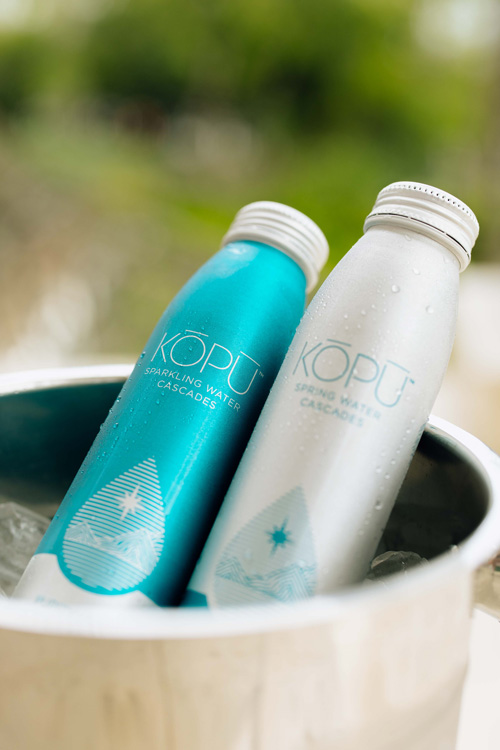
The word “sustainable” has become so diluted in marketing language that it’s almost lost meaning. Brands use it to mean almost anything: slightly less bad than before, partially recyclable, made with marginally fewer resources. But true sustainability—creating systems where materials cycle indefinitely without degradation—is a very specific, very rare thing.
In the world of bottled water packaging, only one material achieves genuine sustainability at scale: aluminum.
This isn’t a close competition. When you actually examine the full lifecycle of water packaging—extraction, manufacturing, use, recycling, and what happens in subsequent cycles—aluminum stands in a category entirely different from plastic, glass, or paper. It’s the only material that can be recycled infinitely without any loss of quality, integrity, or functionality.
KOPU’s commitment to aluminum-only packaging isn’t a sustainability gesture. It’s a foundational decision about what it means to operate with genuine integrity. And that decision is backed by science, economics, and the physics of materials.
Understanding True Recyclability vs. Downcycling
Before we go further, a crucial distinction: being recyclable is not the same as being sustainable.
Most materials can be recycled, at least once. But “recycling” often involves a process called downcycling, where the material’s quality degrades with each cycle. Take plastic. A single-use plastic bottle can be recycled, but the resin chains degrade during the recycling process. The recycled plastic becomes lower quality, more brittle, less suitable for food contact. It gets downgraded to lower-quality applications—textile fibers, plastic lumber, playground equipment—and eventually ends up in a landfill anyway.
Paper and cardboard face similar challenges. Paper fibers can be recycled about 5-7 times before they become too short and weak to bond together. Glass can be recycled, but recycling glass requires significant energy—nearly as much as manufacturing new glass from scratch—and broken glass contaminates recycling streams.
Aluminum is fundamentally different.
Aluminum can be recycled infinitely without any loss of quality. The atomic structure of aluminum doesn’t degrade during the recycling process. The recycled aluminum is chemically identical to virgin aluminum. It can be recycled again, and again, and again, forever, without any loss of integrity.
This isn’t marketing language. This is metallurgy. This is how the periodic table works.
The Full Lifecycle: Examining the Real Environmental Cost
When sustainability advocates compare packaging materials, they look at what’s called the lifecycle assessment (LCA). This evaluates environmental impact at every stage:
1. Extraction and Production
Aluminum production requires energy, and that’s genuinely the biggest environmental cost. Extracting bauxite ore and processing it into aluminum is energy-intensive. If that energy comes from renewable sources, the environmental impact is minimal. If it comes from fossil fuels, the impact is significant.
Here’s the critical fact: aluminum production is increasingly sourced from renewable energy. Many major aluminum producers use hydroelectric power. KOPU partners with suppliers committed to responsible sourcing and renewable energy usage. The industry trend is toward greener aluminum production—and the incentive is strong, because aluminum recycling saves 95% of the energy required for virgin production.
In contrast, plastic production requires continuous fossil fuel input. Every plastic bottle is derived from petroleum or natural gas. There’s no way to make virgin plastic without significant carbon input.
2. Manufacturing
Aluminum bottles are produced from recycled aluminum approximately 80-90% of the time in modern facilities. This means most aluminum bottle production is already using material that’s been recycled many times. This dramatically reduces the environmental cost per bottle.
Plastic bottles are made from virgin resin because recycled plastic degrades. So each “recycled” plastic bottle is still made mostly from new petroleum-derived plastic.
3. Transportation
Aluminum is lighter than glass but durable. A case of aluminum bottles weighs significantly less than glass, reducing transportation emissions. It’s also less fragile, reducing waste from breakage during shipping.
4. Consumer Use
Here’s where the distinction becomes obvious. An aluminum bottle can be resealable (KOPU’s bottles are) and reused for storage before recycling, or used as intended and recycled immediately. It doesn’t degrade whether it’s used once or filled multiple times.
A plastic bottle? With each use, the resin structure degrades slightly. Exposure to sunlight, heat, and repeated filling accelerates degradation. UV exposure can cause plastic to become brittle. This is why many reusable plastic bottles eventually crack and become unusable.
5. End of Life
This is where aluminum’s true advantage emerges.
When an aluminum bottle reaches end of life, it enters the recycling stream. Aluminum recycling has a 50% rate globally (higher in developed nations, with some countries achieving 90%+ recycling rates). Recycled aluminum is melted down and reformed into new bottles. The process requires 95% less energy than virgin production. The material properties are identical.
A plastic bottle, when recycled, is downgraded. Most recycled plastic becomes lower-grade material. Eventually, it becomes non-recyclable waste that sits in a landfill for 400+ years.
Glass can be recycled, but requires substantial energy input and takes up more volume in the recycling stream.
The Comparative Environmental Impact Data

Let’s look at actual lifecycle assessment data from peer-reviewed environmental studies:
| Factor | Aluminum | Plastic | Glass |
| Energy for virgin production | 200 MJ/kg | 100 MJ/kg | 14 MJ/kg |
| Energy for recycled production | 10 MJ/kg | N/A (downcycled) | 11 MJ/kg |
| Recyclability | Infinite | 1-2 times (degraded) | Infinite (with caveats) |
| Recycling rate | 50%+ | 9% | 26-30% |
| Landfill persistence | 200 years | 400+ years | 1 million+ years |
| Weight per bottle | 15g | 25-30g | 200-400g |
| Carbon footprint (recycled) | 0.6 kg CO2 equivalent | 1.9 kg CO2 equivalent | 0.8 kg CO2 equivalent |
| Secondary/tertiary recyclability | Yes (infinite cycles) | No (degrades) | Yes (with caveats) |
The data is clear. When you account for the complete lifecycle and the reality of global recycling systems, aluminum is the only material that achieves genuine sustainability.
The Infinity Cycle: Understanding Circular Economy
This is the core concept that makes aluminum genuinely different.
A circular economy is one where materials cycle indefinitely. Aluminum is one of the few materials that can actually achieve this. An aluminum bottle can be recycled into new aluminum bottles indefinitely. The cycle never ends. The material never degrades. No new extraction is required (beyond the annual inputs lost to landfilling and dispersion).
In theory, if the entire world achieved 100% aluminum recycling, you would never need to mine another ounce of bauxite for beverage bottles. You’d have created a perfect closed loop.
Plastic cannot do this. Glass can achieve it theoretically, but does so at significant energy cost and in practice faces contamination issues in recycling streams.
KOPU’s aluminum bottles are infinitely recyclable. This isn’t hyperbole. It’s literal. A KOPU bottle recycled today could be remade into a KOPU bottle again tomorrow. And then again the day after. And 50 years from now, that same bottle’s material could still be cycling through the system without degradation.
The Aluminum Stewardship Initiative: KOPU’s Commitment to Responsible Sourcing

It’s important to acknowledge that aluminum production does have environmental costs, particularly if energy comes from fossil fuels. KOPU takes this seriously.
KOPU works within the Aluminum Stewardship Initiative (ASI), an international standard that ensures responsible aluminum production and sourcing. This includes commitments to:
- Renewable energy usage: Prioritizing suppliers that use hydroelectric, wind, or other renewable power for production
- Mine reclamation: Ensuring mining areas are properly reclaimed and restored
- Labor standards: Guaranteeing fair labor practices in aluminum production
- Transparency: Full traceability of supply chains and production practices
These aren’t optional marketing checkboxes. They’re verifiable standards that KOPU’s supply chain must meet.
Additionally, KOPU’s commitment to aluminum extends beyond just using aluminum bottles. The company supports the Aluminum Stewardship Program (ASP)—a proprietary initiative ensuring that every bottle produced meets rigorous environmental and ethical standards.
The Plastic Problem: Why Even “Recycled” Plastic Isn’t Actually Sustainable
Let’s be honest about plastic, because the messaging around it is deliberately confusing.
When a plastic bottle is marked as “recyclable,” what that actually means is: “This can be processed in a recycling facility.” What it doesn’t mean is: “This will be recycled, or that recycling it will produce the same quality product.”
The global plastic recycling rate is approximately 9%. This means 91% of plastic bottles ever produced either sit in landfills, are incinerated, or end up in the ocean. And that’s assuming they even reach a recycling facility—most don’t.
Of the plastic that is recycled, the vast majority is downcycled. It becomes lower-quality plastic suitable for one additional use cycle, and then it’s discarded. It doesn’t cycle infinitely. It cycles maybe twice, then ends up in a landfill.
There’s also an emerging problem with recycled plastic: chemical degradation. Recycled plastic used for food contact is increasingly prohibited in some regions because the recycling process doesn’t reliably remove contaminants. This is why most “recycled” plastic isn’t used for new bottles—it’s relegated to non-food applications.
The honest assessment: plastic recycling is greenwashing at scale. It makes the consumer feel better, but it doesn’t solve the problem. Most plastic ever produced is still sitting in a landfill or decomposing in the ocean.
Aluminum doesn’t face these problems. If it’s recycled (and increasingly, it is), it becomes new aluminum of identical quality.
The Carbon Perspective: Lifecycle Emissions
From a climate perspective, the distinction is also dramatic.
Production of virgin aluminum from bauxite ore produces approximately 200 MJ of energy per kilogram, with carbon emissions of about 12-15 kg CO2 equivalent per kilogram of aluminum produced.
But here’s where recycling changes everything: recycled aluminum production requires only 10-15 MJ of energy per kilogram, with carbon emissions dropping to approximately 1-2 kg CO2 equivalent per kilogram.
For a typical 15-gram aluminum bottle, the carbon footprint of production from recycled aluminum is approximately 30-40 grams of CO2 equivalent.
Compare this to plastic: a 25-gram plastic bottle has a carbon footprint of approximately 300-350 grams of CO2 equivalent throughout its lifecycle, much of which occurs even before use.
Over a year, switching from plastic to aluminum bottles can reduce an individual’s packaging-related carbon footprint by several kilograms. Multiply this across a population, and it becomes significant.
The Beauty of Recycled Aluminum: The Bottle That Lives Forever
Here’s something genuinely poetic about aluminum: an old aluminum bottle can become a new aluminum bottle.
The recycling infrastructure for aluminum is mature and well-established. When you recycle an aluminum bottle, it enters a stream that efficiently collects it, sorts it, and sends it to processing facilities where it’s melted and reformed into new bottles or other aluminum products.
The timeline is quick—typically weeks to months from recycling to new bottle. The aluminum maintains its integrity. The new bottle is identical in quality to a bottle made from virgin ore.
This creates what’s called a “closed loop” system in technical terms. The material cycles through use, recycling, and back to use indefinitely.
KOPU bottles are designed with this in mind. The aluminum cans are unmarked internally, contain no problematic coatings, and are processed in standard aluminum recycling streams.
Understanding Why KOPU Chose Aluminum-Only
KOPU’s decision to package exclusively in aluminum isn’t based on a single factor. It emerges from examining all of the evidence:
Environmental Integrity: Aluminum is the only material that achieves genuine sustainability through infinite recyclability.
Brand Alignment: KOPU’s core promise is “Purity is the Ultimate Luxury.” Purity extends to packaging. Using inferior materials would be philosophically inconsistent.
Consumer Values: The customers who choose premium water generally care about environmental impact. Delivering on that commitment means making real choices, not marketing compromises.
Long-Term Thinking: KOPU was founded with a vision of operating responsibly for the next hundred years. That requires choosing materials that don’t degrade with each cycle, because KOPU wants its bottles to still be cycling in 2124.
This isn’t virtue signaling. It’s foundational decision-making about what sustainable actually means.
The Misconception About “Reusable” vs. “Recyclable”
There’s an important legal and semantic distinction that matters here.
KOPU’s bottles are described as “infinitely recyclable” and “resealable,” not “reusable.” This is intentional. “Reusable” implies the bottle is designed for repeated consumer use. “Resealable” acknowledges that you can refill or reseal the bottle before recycling, but the bottle’s primary design is for recycling.
The distinction matters because it shapes expectations and legal liability. A bottle designed for single use can be safer in certain applications. A bottle designed for reuse needs different quality standards and liability frameworks.
KOPU’s bottles are resealable (you can seal them after drinking), but more importantly, they’re designed to move immediately into recycling, where they cycle infinitely.
Comparing the True Sustainability of Popular Water Brands
Let’s look at how KOPU’s sustainability commitment compares to other premium water brands:
| Brand | Packaging | Recyclability | Sustainability Model |
| KOPU | Aluminum (infinitely recyclable) | Infinite cycles | Closed-loop circular |
| Fiji | Plastic | Downcycled once | Linear consumption |
| Evian | Plastic (30% recycled) | Downcycled once | Partially linear |
| Essentia | Plastic | Downcycled once | Linear consumption |
| Smartwater | Plastic | Downcycled once | Linear consumption |
The comparison is stark. No other major bottled water brand has committed to aluminum-only packaging. This is partly because aluminum is more expensive than plastic. But it’s the right choice when you care about actual sustainability rather than marketing sustainability.
The Economics of Aluminum: Why Cost Matters but Integrity Matters More
Yes, aluminum bottles are more expensive than plastic bottles. This is transparent in KOPU’s pricing.
But here’s what that cost represents: it’s the price of actually solving the problem rather than pretending to solve it.
When you choose plastic because it’s cheaper, you’re outsourcing the true cost to the environment and future generations. That cost still exists—it’s just not reflected in the bottle’s price. It’s absorbed by the planet.
When you choose aluminum, you’re saying: “I’ll pay more now because I don’t want to pay infinitely more later by destroying ecosystems and filling landfills.”
From an economics perspective, choosing aluminum is rational. The consumer bears the honest cost of sustainable packaging upfront, rather than expecting future generations to bear the invisible cost.
FAQ: Aluminum, Sustainability, and Your Choices
Q: Isn’t mining aluminum also bad for the environment? A: Mining does have environmental impacts, but recycling eliminates 95% of the need for new mining. As recycling rates improve, the per-bottle environmental cost of aluminum decreases. This creates an incentive loop toward improvement.
Q: What if aluminum recycling rates don’t improve? A: Even at current 50% global recycling rates, aluminum outperforms plastic (9% recycling rate) dramatically. Aluminum’s infinite recyclability means every bottle recycled can become a new bottle. Plastic cannot.
Q: Can I recycle KOPU bottles at home? A: Yes. KOPU aluminum bottles go in standard aluminum recycling. Check your local guidelines for curbside programs.
Q: Does aluminum leach into water? A: No. Aluminum bottles have food-safe linings that prevent any contact between aluminum and the water inside. This is a solved problem in beverage container design.
Q: Is aluminum recycling profitable? A: Yes. Aluminum has significant scrap value, which incentivizes collection and recycling. This is why aluminum recycling rates are relatively high compared to other materials.
Q: What happens to KOPU bottles that aren’t recycled? A: They persist in the environment for approximately 200 years. This is significantly better than plastic (400+ years) and comparable to glass, but ideally, the goal is 100% recycling.
Q: Doesn’t aluminum recycling also require energy? A: Yes, but 95% less than virgin production. Over multiple recycling cycles, aluminum’s energy footprint becomes negligible.
Q: Why do other water brands use plastic? A: Cost. Plastic bottles are cheaper to produce than aluminum. When sustainability isn’t a core brand value, the cost difference dominates the decision.
The Integrity Standard: What Sustainability Actually Means
At the deepest level, KOPU’s choice of aluminum represents a commitment to integrity. It’s saying: “We mean it when we talk about sustainability. We’re willing to pay the cost and accept the complexity of doing it right.”
This is what separates genuine sustainability from greenwashing. Genuine sustainability involves real choices with real tradeoffs. It requires willingness to pay more, to accept greater complexity, and to prioritize long-term impact over short-term convenience.
KOPU’s aluminum bottles represent that commitment. Every bottle is infinitely recyclable. Every bottle can cycle through the system indefinitely. No degradation. No downcycling. No eventual landfill persistence.
That’s what true sustainability looks like.
Discover KOPU Water’s sustainability commitment and learn more about our aluminum-only packaging and Aluminum Stewardship Program.
Or explore our complete water product line packaged with genuine sustainability in mind.
Purity is the Ultimate Luxury.
